01 / 10
Novapunks Dispatch — Issue 005

THE
MONEY
WAR

Central Bank Digital Currencies. Programmable money. Inflation as policy. The state has always controlled the monetary system — but never with tools this precise. The fight for sound money is the fight for everything else.

Monetary history is the history of debasement
02 / 10
Monetary History

Money Has Always
Been a Weapon

The history of money is the history of control. From the moment states discovered they could debase coinage — shaving silver from the edges, reducing gold content, then simply declaring paper to be worth its face value — monetary policy became the primary tool of political power. Roman emperors paid for endless wars through currency debasement. Medieval monarchs funded their courts by clipping coins and re-minting them lighter. Modern central banks achieve the same effect through interest rate policy, quantitative easing, and the creation of money from nothing.

Murray Rothbard's history of money traces the consistent pattern: free-market commodity money, which cannot be manipulated because its supply is governed by natural scarcity and production costs, is systematically replaced by state-controlled fiat money whenever states face fiscal pressure. The gold standard was not abandoned because gold was technically inferior as money. It was abandoned because it constrained governments' ability to spend beyond their means.

The Austrian school's analysis of money is not merely historical. It identifies a structural feature of any monetary system controlled by a state: the monopoly on money creation is a monopoly on the most important price in the economy — the price of money itself, expressed as the interest rate. When that price is manipulated, it sends false signals throughout the entire capital structure. Malinvestment follows. Booms are created artificially and busts are the inevitable correction.

The invention of digital payment infrastructure gave governments a new set of tools for monetary control that coin-clippers and printing presses could never provide. The surveillance of transactions at scale. The ability to freeze accounts without judicial process. Capital controls enforced at the protocol level. The trajectory was clear before CBDCs were proposed. CBDCs are the endpoint of a direction of travel that has been consistent for decades.

03 / 10
Central Bank Digital Currencies

The CBDC Offensive:
Programmable Control

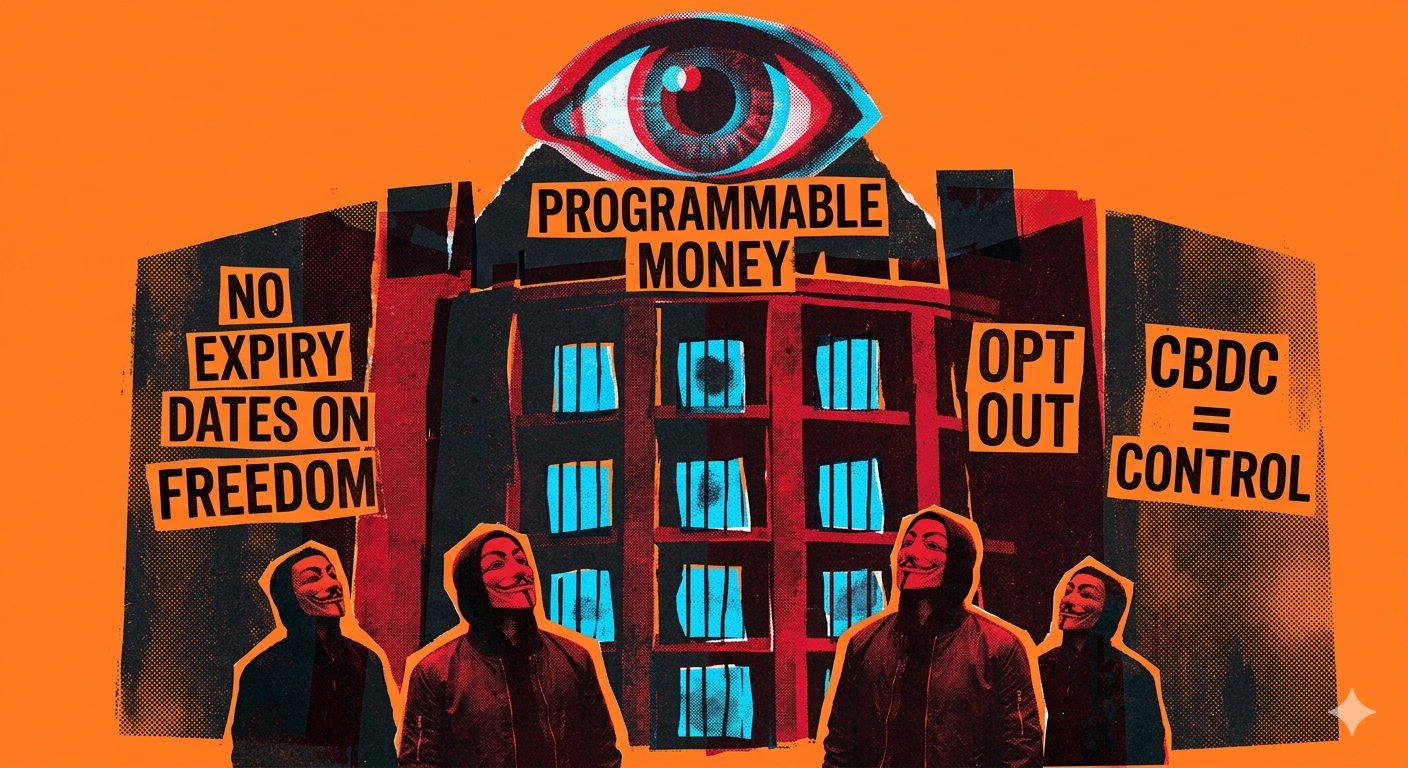
As of 2024, over 130 countries representing more than 98% of global GDP are at some stage of CBDC exploration, development, or deployment. The Bank for International Settlements — the central bank of central banks — has been the primary coordinating institution for this development. The political rhetoric frames CBDCs as financial inclusion initiatives, efficiency improvements, or tools for reducing payment costs. The technical architectures reveal something different.

The defining feature of a CBDC — the feature that distinguishes it from digital money that already exists in the form of bank deposits — is programmability. A programmable currency can have expiration dates, forcing spending before a set time. It can be restricted to certain categories of goods and services. It can be automatically taxed at the point of transaction. It can be frozen or confiscated without judicial oversight, at the instruction of a government agency, faster than any legal process could challenge the action. These are not hypothetical features — they are documented in the design specifications of deployed systems.

China's digital yuan — the e-CNY — is the most advanced deployed CBDC system in the world and the most instructive case study. It provides the People's Bank of China with transaction-level visibility into the spending of any holder. The system includes "controllable anonymity" — anonymity from other users and merchants, but full transparency to the central bank and the state. Unlike cash, no transaction can be made outside the surveillance perimeter.

The United States Federal Reserve has publicly framed its CBDC exploration as a response to China's head start. The political window to prevent deployment is narrow and narrowing. The architecture of financial surveillance, once deployed, creates institutional incentives for its own expansion that are very difficult to reverse through legislative means.

Inflation — the tax they never vote on
04 / 10
Inflation

The Tax They
Never Vote On

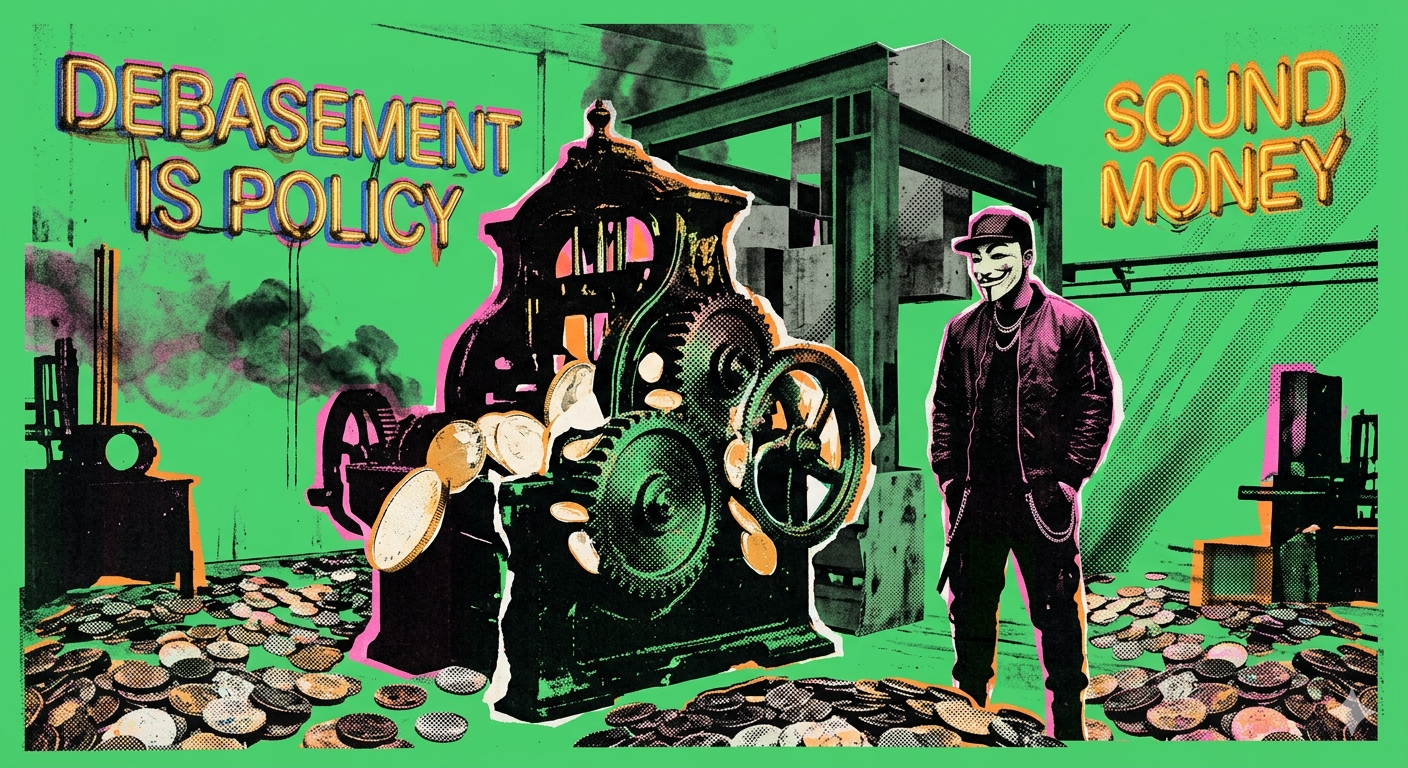
Inflation is taxation without legislation. When a government expands the money supply, the purchasing power of existing money holders declines — their savings buy less, their wages have less real value, and the wealth they have accumulated over a lifetime is steadily transferred to whoever received the newly created money first. This transfer is invisible in the way that explicit taxation is not: no tax return, no assessment notice, no audit. The mechanism requires no consent and no political process.

The wealth distribution effect of inflation is well documented and consistently regressive. Those who hold significant financial assets — equities, real estate, commodities — see their wealth approximately preserved or increased as asset prices inflate along with the money supply. Those who hold their wealth in cash savings, fixed-income instruments, or simply in the form of wages that lag price increases, experience real wealth destruction. The post-2008 period of quantitative easing was perhaps the largest deliberate upward redistribution of wealth in the history of modern economies.

The Austrian business cycle theory predicts that artificially low interest rates create malinvestment: the allocation of capital to projects that appear profitable at low interest rates but would not be profitable at rates that accurately reflect the real cost of capital. The dot-com bubble, the 2008 housing crisis, the 2021–2022 tech valuation bubble, the collapse of crypto projects predicated on zero-cost leverage — each follows the same pattern.

Sound money advocates do not argue that economies should never have credit. The argument is structural: in a free market for money, interest rates emerge from the voluntary decisions of savers and borrowers and convey real information about time preference and the availability of capital. That information is destroyed by central bank rate-setting. The economy loses the price signal that coordinates intertemporal decision-making.

05 / 10
Bitcoin & Sound Money

Bitcoin and
the Austrian Standard

Satoshi Nakamoto's whitepaper was published in October 2008, at the height of the financial crisis that the Federal Reserve's decade of artificially low interest rates had produced. Bitcoin's genesis block contained an embedded message — a London Times headline: "Chancellor on brink of second bailout for banks." The monetary philosophy embedded in Bitcoin's design is not libertarian by accident. It is Austrian by architecture.

The 21 million cap on Bitcoin's supply is the technical implementation of sound money's core requirement: scarcity that cannot be manipulated by any institution. As Saifedean Ammous argues in The Bitcoin Standard, the more relevant property is stock-to-flow ratio: the relationship between existing supply and new production. Bitcoin's halving mechanism creates a stock-to-flow ratio that exceeds gold's after every halving cycle and approaches infinity as the supply cap is approached. No committee decides this. No crisis overrides it. The code enforces it regardless of political pressure.

The Lightning Network extends Bitcoin's monetary architecture into the payment layer. By moving the majority of transactions off the main chain into payment channels that settle periodically, Lightning enables near-instant, near-zero-cost payments at global scale. The technical architecture enables a genuinely decentralized payment system: no payment processor, no merchant account, no chargebacks, no KYC for channel usage, no account freezing.

The Austrian critique of Bitcoin centers on its volatility — the argument that a store of value whose purchasing power fluctuates dramatically cannot function as a unit of account. This criticism has less force as Bitcoin's market capitalization grows and its volatility has trended lower over successive market cycles. Bitcoin's volatility is the price discovery process of a young monetary asset establishing its value relative to existing monetary systems.

The institutional adoption of Bitcoin as a treasury reserve asset — by MicroStrategy, by El Salvador's national treasury, by a growing number of corporations and family offices — represents the first phase of a Gresham's Law inversion. As Bitcoin demonstrates superior monetary properties relative to fiat currency, the rational response is exactly what is being observed: institutions and individuals accumulating Bitcoin as savings and using fiat for current expenditure.

06 / 10
Sound Money

Hard Money:
Why Gold Still Matters

Gold's five-thousand-year track record as money is not nostalgia. It is the empirical record of which monetary technologies have survived the test of institutional aggression — every attempt by states and banks to debase, replace, or suppress commodity money. Gold survived because it has properties that made it uniquely resistant to such attempts: it cannot be created from nothing, its production is governed by geological reality and the economics of mining, it does not decay, it is divisible, portable, and universally recognized.

The case for gold in the current monetary environment is not that it will replace fiat — that window closed with the abandonment of Bretton Woods. It is that gold serves as a monetary insurance policy: an asset whose value is not correlated with the creditworthiness of any counterparty, that cannot be inflated by any central bank, and that has consistently maintained purchasing power over multi-decade periods against every fiat currency in which it is measured.

The relationship between gold and Bitcoin in a sound money portfolio is more complementary than competitive. Gold provides physical, non-digital insurance against extreme scenarios — grid-down situations, internet shutdown, jurisdictional seizure of digital assets. Bitcoin provides digital, censorship-resistant, bearer-instrument money with superior portability and verifiability. Together they constitute a sound money position that covers different risk scenarios.

Central banks themselves have been net buyers of gold for over a decade, with purchases accelerating dramatically after the United States and allied governments froze $300 billion of Russian central bank reserves in 2022. That action demonstrated, to every central bank with any strategic exposure to US-aligned financial infrastructure, that dollar reserves held in Western custodians were not safe from political seizure. The scramble for gold by the very institutions responsible for the fiat system's architecture is the most eloquent testimony to gold's continued monetary relevance.

07 / 10
Privacy Coins

Monero and
the Last Line

Bitcoin is sound money. It is not private money. Every transaction on the Bitcoin blockchain is permanently public, forever linkable to sender and receiver addresses, and increasingly traceable through chain analytics software deployed by firms like Chainalysis that work directly with government agencies to identify transaction parties. The pseudonymity of Bitcoin addresses is not anonymity — it is obfuscation that was never designed to be surveillance-resistant and has not proven to be.

Monero was designed from the ground up to solve this problem. Ring signatures obscure which transaction output is being spent among a set of decoys, making it impossible to trace the origin of any payment. Stealth addresses ensure that each transaction sends to a one-time address that cannot be linked to the recipient's public address. RingCT hides transaction amounts so that no observer can determine how much value was transferred. These three technologies combine to produce a monetary system in which every transaction is, by default and by protocol, unlinkable and untraceable.

The regulatory response to Monero has been exactly what its properties would predict: delisting from regulated exchanges in multiple jurisdictions, Treasury Department sanctions against mixer services that enhanced Bitcoin privacy, IRS bounties for software that can crack Monero's privacy. Governments do not attempt to suppress technologies that are merely inconvenient. They suppress technologies that threaten the surveillance infrastructure on which financial control depends.

The counter-economic case for Monero is straightforward. In a world where financial surveillance is the primary infrastructure of state control over economic behavior — where account freezing, de-banking, asset seizure, and transaction monitoring are routine tools of political enforcement — a monetary system that is technically incapable of providing that surveillance to any authority is the financial equivalent of end-to-end encryption: the baseline infrastructure of economic autonomy.

08 / 10
Exit Strategy

The Monetary Exit Stack

"Exit from the fiat monetary system is not a single action. It is a layered strategy."

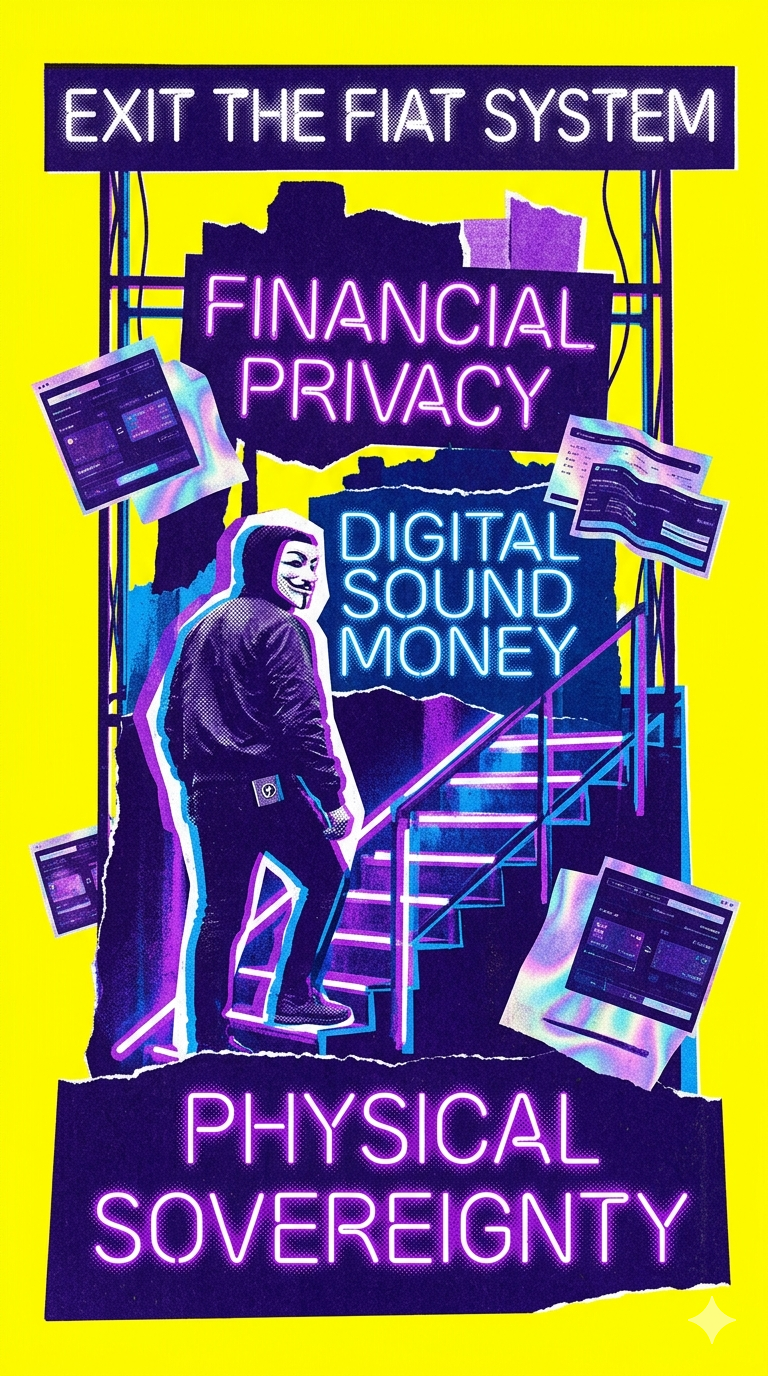
Exit from the fiat monetary system is not a single action. It is a layered strategy that moves progressively from the most exposed position — holding wealth entirely in state-controlled fiat and institutional financial infrastructure — to the most sovereign position: holding wealth in instruments that are censorship-resistant, bearer-form, and not subject to institutional control.

The first layer of the exit is holding assets that are not correlated with fiat monetary policy: physical gold and silver in self-custody, outside the banking system. The second layer is Bitcoin: self-custodied on hardware wallets, transactable over Lightning without intermediaries. The third layer is Monero: the privacy layer that provides financial anonymity for transactions where Bitcoin's public ledger creates unacceptable exposure.

Non-custodial decentralized exchanges are the infrastructure that makes this stack functional. Atomic swaps between Bitcoin and Monero, cross-chain DEX protocols, and Lightning-native exchange mechanisms allow movement between layers without requiring account creation, identity verification, or interaction with regulated custodians. The goal is a complete monetary flow that begins with income in fiat, converts to hard assets at the entry point, and transacts within the stack without re-entering the surveillance infrastructure except when operationally necessary.

The geopolitical dimension of monetary exit is worth naming directly. The BIS's Project mBridge — a cross-border CBDC interoperability framework involving China, Hong Kong, Thailand, the UAE, and Saudi Arabia — represents a parallel financial infrastructure specifically designed to settle international trade outside the SWIFT system. The bifurcation of the global monetary system into competing CBDC networks is underway. In this environment, assets that are architecturally outside both networks — gold, Bitcoin, Monero — are not fringe tools. They are the monetary neutrality option.

09 / 10
Synthesis

The Sound Money
Thesis

The sound money thesis is not a prediction about what will happen. It is an analysis of what has always happened and a strategy built on that analysis. States with the ability to create money have always, eventually, created more money than their economies could absorb without price distortion. The incentives are structural and overwhelming: the ability to fund government expenditure without explicit taxation, to bail out politically important institutions without democratic accountability, to suppress interest rates to make debt serviceable that would otherwise default. No democratic government has consistently resisted these incentives over long periods.

The sound money thesis says: given that the monetary system you are embedded in will be debased over time, and given that the rate of debasement is accelerating as the debt levels that require servicing grow, the rational strategy is to hold wealth in instruments that cannot be debased. Not because you are predicting a specific collapse event at a specific time — but because the direction of travel is clear and the insurance cost of holding hard assets is low relative to the risk.

The Austrian economists who developed the theoretical foundation for this analysis — Mises, Hayek, Rothbard — were largely dismissed as ideologues during the decades when the dollar standard provided relative monetary stability. The post-2008 period changed the terms of the debate. The Federal Reserve's balance sheet expansion from $900 billion to $9 trillion, the European Central Bank's negative interest rate policy, Japan's yield curve control effectively nationalizing the bond market, the post-COVID inflation spike — these are documented events in the mainstream financial record that vindicate the core Austrian prediction.

The Bitcoin Standard, The Road to Serfdom, Human Action, Man Economy and State — these texts are the analytical framework for understanding the monetary environment you are currently living in. The question they all converge on is the same: given that the state will expand the money supply to serve its own interests, what do you do? The answer was always some form of the same thing: hold your wealth in instruments the state cannot inflate. Gold was the historical answer. Bitcoin is the digital-age answer. Monero is the answer for those who also value the privacy that cash used to provide.

10 / 10
The Declaration

Financial
Independence

"The money war has been running for centuries. For the first time in history, individuals can hold monetary instruments that are mathematically protected against debasement and cryptographically resistant to seizure."

The money war has been running for centuries. It is the war between those who wish to control the money supply and those who wish to preserve their purchasing power against that control. For most of history, ordinary people had no good options: gold and silver could be confiscated, their use criminalized, or their monetary role legally ended by fiat. The technological developments of the past fifteen years have changed the options available. For the first time in history, individuals can hold monetary instruments that are mathematically protected against debasement and cryptographically resistant to seizure.

The CBDC project, understood clearly, is the state's attempt to close the window that Bitcoin opened. The goal is a monetary system with no cash, no bearer instruments, complete transaction surveillance, and programmable restrictions on economic activity. If this system achieves full implementation and cash is eliminated as an alternative, the financial autonomy that has always existed as a residual right of physical currency holders disappears entirely.

The urgency of the sound money position is not about investment returns or ideological preference. It is about the window of time that exists between the current moment — in which alternatives to the CBDC financial system still exist, can be acquired, and can be used — and a future moment in which that window may be closed. The tools for financial independence are available now. The regulatory environment, while hostile and tightening, still permits their use. None of this is guaranteed to remain true indefinitely.

The declaration of financial independence is not a political manifesto. It is a personal decision made by each individual who understands the monetary environment they are living in and acts accordingly. It begins with the recognition that the money in your bank account is not your money — it is an unsecured liability of a financial institution. It ends with the recognition that financial sovereignty is available to anyone willing to understand the tools and use them. The money war is already happening. The only question is which side of it you are on.