01 / 10
Novapunks Dispatch — Issue 007

THE
GREAT
EXIT

The institutions have failed. Not through incompetence — by design. The central banks cannot produce sound money. The international bodies cannot produce health or peace. The media cannot produce truth. And the democratic process cannot produce accountability because every lever of production belongs to those who built the machine. The agorist answer has always been the same: don't fix the machine. Build a different one.

02 / 10
Diagnosis

The Architecture
of Capture

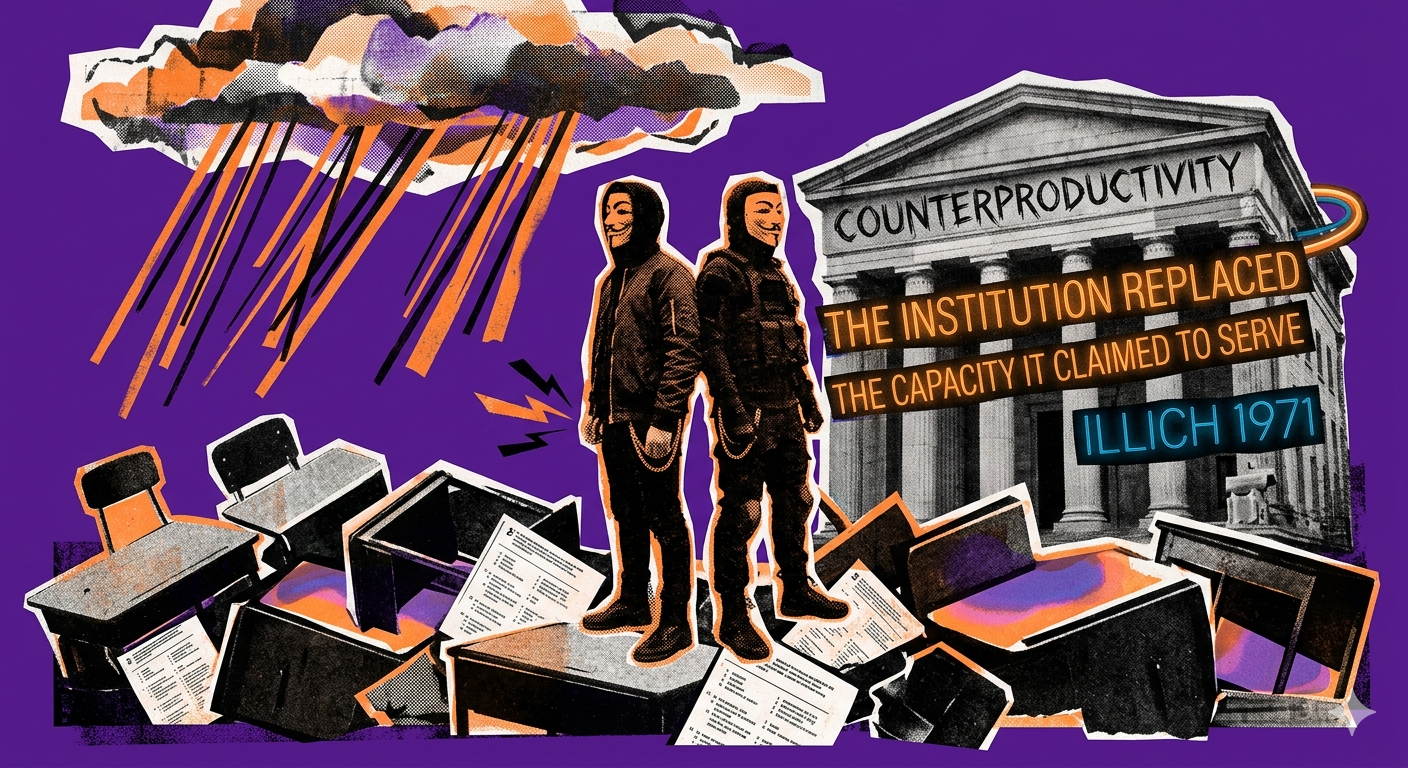
Ivan Illich identified the pattern fifty years ago and called it counterproductivity: beyond a threshold, institutions designed to serve a purpose begin to undermine it. Schools decrease learning above a certain scale. Hospitals decrease health. Police decrease safety. The observation was not cynical — it was structural. Large institutions require self-perpetuation as their primary operating logic. Serving the stated mission is secondary to maintaining the budget, the headcount, the regulatory territory, and the political relationships that guarantee survival. The mission drift is not corruption. It is the predictable output of the incentive architecture.

But Illich was describing the organic logic of all large institutions. What has happened to the major institutions of the current era — central banking, international governance bodies, the pharmaceutical-regulatory complex, the legacy media apparatus — is something more deliberate. These institutions were not merely drifting from their missions. They were progressively aligned toward a different one: the management of populations through the control of money, information, and the institutional definition of acceptable behavior. The alignment was achieved through the same mechanism Mises described for all captured systems: control the money supply and you control everything downstream of it.

The global debt edifice — a figure that dwarfs world GDP by a significant multiple — was not an accident of policy error. Debt is the mechanism through which institutions maintain leverage over the individuals, businesses, and governments beneath them. A nation that can print nothing and owes everything must comply. A business that cannot access credit on reasonable terms cannot compete. An individual who cannot service their debt cannot refuse. The control architecture is elegant precisely because it operates through voluntary-seeming transactions that create genuine obligations, and those obligations create compliance without requiring direct coercion. The chains are financial, not physical, which makes them culturally invisible and legally unassailable.

Hayek described the knowledge problem: no central planner can aggregate the dispersed local knowledge that prices spontaneously encode. But the institutions that captured the money supply were not trying to solve the knowledge problem. They were trying to exploit it. A system in which only accredited institutions can create money and only credentialed intermediaries can adjudicate its use is a system in which every transaction passes through a chokepoint. The chokepoint is the point of control. The debt architecture is the control architecture.

03 / 10
Strategy

The Reform
Illusion

Karl Hess spent the first half of his life in Republican Party politics — speechwriter for Goldwater, operative for the conservative establishment. He came out the other side welding. Not as a gesture of defeat but as a strategic conclusion. The closer he came to the machinery of institutional power, the clearer it became that the machinery did not produce what it claimed to produce. Political parties did not produce liberty. They produced power for those who ran them. The reformers who entered the system became the system within a single election cycle. This was not failure of character. It was the operating logic of capture — whoever touches the machine is touched by the machine.

Rothbard analyzed the same dynamic from first principles. Every government intervention in a market creates distortions that appear to demand further interventions. The logic leads toward full control or full withdrawal — there is no stable middle position. Those who attempt to reform interventionist systems from within are forced to propose further interventions as the remedy for prior interventions. The reformer who enters the legislature to cut the budget finds themselves defending the agencies they failed to cut against the next round of reformers. The institutional logic always wins because the institutional logic has the resources, the tenure, the relationships, and the accumulated regulatory capture of decades. The individual reformer has their term limit and their principle.

Konkin drew the sharpest conclusion: electoral politics is not merely ineffective as a strategy for liberty — it is actively counterproductive. Every campaign spent trying to elect the correct candidates is a campaign not spent building counter-economic alternatives that actually work. Every dollar donated to a political party is a dollar not spent on the infrastructure of the parallel economy. Every hour spent arguing about which faction is less harmful to freedom is an hour not spent building the tools, relationships, and institutions that make the state structurally irrelevant. The opportunity cost of reform is the construction that doesn't happen while we are distracted by the machinery of managed political change.

04 / 10
Architecture

The Counter-Institution
Blueprint

Konkin's counter-economic theory describes a staged process that begins with individuals and ends with civilizational transformation. The first stage is personal: reduce exposure to the state economy wherever possible. Use cash. Barter skills. Build reciprocal relationships outside institutional mediation. Pay for services outside the regulated market. These are not dramatic acts — they are the normal activities of every human economy throughout most of history, now performed with conscious intent. Each such transaction simultaneously provides genuine value and withdraws a quantum of participation from the system that requires participation to function.

The second stage is organizational: counter-economic enterprises that provide what the white market provides, but at smaller scale, with greater accountability, without the regulatory overhead that inflates cost and reduces quality. The informal contractor who charges half the licensed rate and does better work. The underground healthcare provider who charges a fraction of the insured rate for straightforward cases. The unlicensed financial adviser who gives honest counsel because their reputation is their only credential. These are not criminals — they are the market providing services that the licensed-and-regulated apparatus has priced out of reach for those it was supposedly designed to serve.

The third stage is institutional: parallel organizations that provide at community scale what the captured institutions fail to provide. Mutual aid networks that perform genuine risk-sharing rather than risk-extraction. Community land trusts that remove housing from the speculative market. Skill-share economies that create genuine reciprocity. Cooperative financial institutions that lend at cost rather than for profit. Local energy production that removes dependence on the grid and its owners. At this stage, the counter-economy begins to look less like a collection of workarounds and more like an alternative civilization operating in the shadow of the captured one — and the shadow is growing.

The fourth stage — the one Konkin described and the one we are collectively approaching — is the point at which the counter-economy achieves sufficient scale that the state's claim to necessary monopoly on its functions becomes obviously false. When communities can settle disputes, produce food, generate energy, educate children, manage health, and create and exchange value without any mandatory participation in state-administered systems, the legitimacy argument that sustains those systems evaporates. The state cannot remain credible as the provider of last resort when an increasingly visible parallel system provides the same functions at higher quality and lower cost. This does not require revolution. It only requires construction.

05 / 10
Sound Money

The Money Exit

"Money is the first layer of the control stack. Exit it first and everything else becomes easier."

Menger demonstrated in 1892 that money was not invented by governments. It emerged spontaneously when traders discovered that certain commodities — cattle, shells, silver, gold — were accepted by more parties in more circumstances than others, making them useful as indirect exchange intermediaries. No authority decreed it. No contract established it. The most saleable commodity naturally became money because holding it minimized exchange friction for everyone. The spontaneous emergence of sound money across unconnected civilizations, without legal compulsion, is the empirical refutation of the claim that fiat money with a government guarantee is the only viable monetary system. The guarantee is not the source of money's value. It is a retrofit imposed on a preexisting spontaneous order.

What the fiat system provides that sound money cannot is the capacity for the issuer to create money at will. This is not a feature. It is the mechanism. Central bank money creation is the primary tool through which the institutional control architecture maintains itself — inflation is a tax that requires no vote, no constituency, and no justification. The debt architecture depends on it: debt issued at near-zero rates creates obligations; inflation erodes the real value of savings held outside the system; the resulting transfer of wealth is invisible in individual transactions and massive in aggregate. The beneficiaries of monetary expansion are those who receive the new money first — financial institutions and governments. The losers are those who receive it last — wage earners and savers. This is not an accidental distributional outcome. It is the operating logic of fiat money.

Bitcoin restores the spontaneous emergence principle at digital scale. Its supply is fixed, its issuance schedule is immutable, and no authority controls it — exactly the properties that gold possesses and that made gold converge as money across cultures without coordination. Monero extends this with full transaction privacy, removing the final leverage point that makes programmable money a surveillance tool. A currency in which sender, receiver, and amount are cryptographically obscured cannot be weaponized as a compliance mechanism. It cannot be frozen. It cannot be programmatically restricted to approved categories of purchase. These are precisely the properties that make it threatening to the control architecture — and precisely the properties that make it the correct choice for anyone who takes seriously the connection between monetary freedom and every other kind of freedom.

The Central Bank Digital Currency project is the endpoint of the trajectory that began when the gold standard was abandoned. CBDC is programmable money: money that can be designed to expire, restricted to approved merchants, disabled for political dissidents, and exhaustively tracked at the transaction level. It is not a payment system. It is a social management system that happens to move value as a side effect. The counter is not protest or lobbying — it is adoption of monetary alternatives that make it structurally irrelevant. Every transaction in Bitcoin or Monero is a transaction that does not pass through the CBDC infrastructure. Scale is the strategy. Every participant who opts out makes the alternative infrastructure more liquid and more capable of providing everything the CBDC apparatus promises, while delivering everything the CBDC apparatus cannot: privacy, autonomy, and resistance to the chokepoint.

06 / 10
Community Technology

The Community
Layer

Karl Hess's experiments in Adams-Morgan, Washington D.C. — rooftop aquaponics, neighborhood tool libraries, community workshops — were not demonstrations of romantic primitivism. They were engineering projects. His thesis, developed across Community Technology and Neighborhood Power (cowritten with David Morris), was precise: most functions currently monopolized by large centralized systems can be performed better at neighborhood scale using appropriate technology. The claim was not that communities should abandon modern technology. It was that the scale at which technology is deployed determines who controls it — and that the appropriate scale for most human needs is much smaller than the scale at which control is currently exercised.

The evidence has continued to accumulate in Hess's favor. A neighborhood with community solar panels is immune to utility price manipulation. A neighborhood with community food production is immune to supply chain disruption. A neighborhood with community skills networks is immune to the economic shock of losing access to the services those skills provide. Resilience is not a political philosophy — it is an engineering specification. A resilient community is one in which the critical functions of daily life are not dependent on the continued goodwill of distant institutions whose interests do not align with the community's survival.

The practical toolkit has expanded dramatically beyond what Hess worked with. Open-source hardware designs enable community fabrication of tools that previously required industrial supply chains. Mesh networks provide local communication infrastructure that functions without internet backbone. Permaculture design principles, now decades refined, enable food production at density levels that Hess's rooftop experiments anticipated. Three-dimensional printing technology has made the local fabrication of mechanical components economically feasible at community scale. The tools exist. The knowledge is freely available. The limiting factor is not technical. It is the decision to begin — to recognize that community-scale production is not a fallback for when the centralized infrastructure fails, but the infrastructure that should have been built first.

07 / 10
Governance

The Governance
Exit

Hess's "Death of Politics" was not a counsel of despair. It was a redirection of energy. The political process within captured institutions reproduces the logic of capture regardless of which candidates prevail — the machinery transforms the inputs. What Hess proposed, and what he spent the second half of his life demonstrating, was that the functions people expect from governance — dispute resolution, collective decision-making, resource management, community protection — can all be provided by voluntary, locally accountable institutions that do not require the monopoly on force that distinguishes the state from all other institutions.

The network state concept extends this logic to the digital realm. A community organized around shared values, capable of coordinating economically and socially, choosing its own rules and enforcing them through reputation and smart contract rather than coercion, is a governance system. Its jurisdiction is not geographic — it is opt-in. Its legitimacy derives not from monopoly on violence within a territory but from the voluntary participation of those it governs. The network state is not a metaphor for a social media group. It is the recognition that governance has always been fundamentally about coordination, not coercion — and that the coordination problem can now be solved without the coercive apparatus that historically bundled itself to the solution.

Decentralized autonomous organizations are the technical infrastructure for this model: code that enforces agreed rules transparently, without the discretionary interpretation that converts every human institution into an instrument of those who control the interpretation. A DAO does not have officials who can be lobbied, bribed, or pressured into favorable readings of the rules. The rules execute as written. This is not perfect governance — but it is governance that cannot be captured by the means that have captured every large human institution in history. The governance exit does not require choosing between the available political parties. It requires building the institution that makes both of them structurally irrelevant to your life.

08 / 10
Sovereignty

The Identity
Layer

The surveillance ID stack — the combination of government-issued identity documents, biometric databases, device fingerprinting, behavioral tracking, and financial transaction monitoring — was not designed to serve the individuals it catalogues. It was designed to make them legible to institutions. James C. Scott's analysis of state legibility applies precisely here: the state must make its population readable before it can manage it. A population whose transactions are opaque, whose movements are untracked, whose communications are unmonitored is a population that cannot be priced, scored, profiled, and controlled at the individual level. The surveillance infrastructure is the prerequisite for the control infrastructure — not a byproduct of it.

The identity layer of the parallel civilization is the set of tools and practices that restore individual opacity. It begins with understanding which identifiers are truly mandatory and which are voluntary — most surveillance is predicated on identifiers that individuals provide without coercion simply because opting out has been made inconvenient. It continues with adopting cryptographic identity systems where possible: Nostr keys, self-sovereign identity protocols, privacy-preserving authentication that provides proof of credential without disclosure of identity. And it extends to the full operational security stack: Tor, privacy-by-default operating systems, encrypted storage, and the consistent practice of providing the minimum information required and nothing more.

This is not paranoia. It is the recognition that every identifier you provide to an institution creates a data point that will be used in ways you did not consent to, cannot audit, and cannot retract. The behavioral profile assembled from your transactions, movements, communications, and social graph is not owned by you — it is owned by those who assembled it, sold to those who paid for it, and available to governments who request it. Self-sovereign identity is not about hiding criminal activity. It is about recovering the privacy that all human beings possessed before the surveillance infrastructure made it technically and economically feasible to strip it away without asking. The tools are built. The choice is yours.

09 / 10
Synthesis

The Full
Stack

"The parallel civilization is not a future project. It is already being assembled, layer by layer, by everyone who decided to stop waiting for permission."

The parallel civilization is not a single thing. It is a stack — a set of interlocking layers, each solving a specific component of the dependency on captured institutions. The layers reinforce each other. Exit at any one layer strengthens the case for exit at every other. And exit at every layer simultaneously is the state that constitutes what Konkin's model called the full counter-economy: a life that can be lived with genuine autonomy, without mandatory participation in any system whose values conflict with your own.

The money layer is Bitcoin and Monero. Sound, unseizable, private, uncensored. Every transaction in sound money is a transaction outside the debt-based control architecture. The money layer enables the community layer by providing the exchange medium that does not pass through institutional chokepoints.

The community layer is Hess's legacy updated for the present. Local food production. Community energy. Shared tools and skills. The neighborhood-scale institutions that provide genuine resilience rather than delegating all critical functions to distant systems whose stability you cannot influence. The community layer enables the governance layer by creating the material foundation — the genuine interdependence — that gives governance meaning.

The communication layer is Nostr and the full cryptographic stack: end-to-end encrypted messaging, content-addressed storage, censorship-resistant publication. The communication layer enables everything else by providing the infrastructure for coordination that cannot be deplatformed. When the communication layer is functional, the community can organize, the money can circulate, the governance can deliberate. Without it, each of the other layers is isolated and therefore vulnerable.

The identity layer is self-sovereign cryptographic identity and the consistent practice of minimum disclosure. It protects all the other layers by making the participants in the parallel civilization illegible to those who would surveil and disrupt it. Identity sovereignty is the meta-layer that determines whether all the other layers can operate without constant interference from a surveillance apparatus that is increasingly comprehensive and increasingly aggressive.

The governance layer is voluntary, opt-in, and technically enforced through smart contracts and reputation systems where possible. It provides dispute resolution, collective decision-making, and community rule-setting without requiring any monopoly on force. It is the layer that makes the parallel civilization recognizable as a civilization rather than merely a collection of independent individuals who happen to use the same tools.

The stack is not yet seamless. The user experience of coordinating across all five layers simultaneously is not as polished as participating in the institutional systems they replace. The tools are real, they work, and they are improving rapidly — but the network effects that make them genuinely competitive with the incumbent infrastructure require more participants. Every person who joins any layer of the stack contributes to the network effects that make it viable for everyone else. The transition is the construction phase. The destination is a civilization that the captured institutions cannot touch because there are no chokepoints in it to compress.

10 / 10
Closing

Build First,
Debate Later

"The great exit is not a rejection of civilization. It is the construction of a better one — voluntary, human-scale, technically resilient, and impossible to capture."

The great exit is not an act of hatred toward those who remain inside captured institutions. It is not an abandonment of community or social responsibility. It is the recognition that the most responsible thing a person can do, in a world whose major institutions have been redirected away from human flourishing, is to build the institutions that haven't been captured yet. That construction is both a personal act — securing your own sovereignty — and a political act — demonstrating that the captured institutions are not necessary.

Every functional counter-economic enterprise makes the case that the state's claimed monopoly on its functions is false. Every community food system makes the case that agricultural dependency is a policy choice, not a necessity. Every mutual aid network makes the case that insurance industry extraction is optional. Every privacy tool demonstrates that surveillance is a design decision, not an inevitability. The construction is also the argument. You do not need to win the debate before building the alternative. You build the alternative and the debate resolves itself.

The historical evidence is unambiguous. Every previous expansion of human freedom came not from the reform of existing institutions but from the construction of alternatives that made those institutions structurally obsolete. The printing press did not reform the scriptoria — it made them irrelevant. The internet did not reform broadcast media — it made it increasingly irrelevant. Bitcoin did not reform central banking — it introduced a monetary system that does not require it. The pattern is clear. The tools for the current phase of the same pattern are available, functional, and freely accessible. The question is no longer whether the parallel civilization can be built. It is being built. The question is whether you are building it.

Start with whatever layer is most accessible from your current position. If you earn in fiat, hold in Bitcoin. If you use centralized communication, move one conversation to Signal or Nostr. If you buy all your food from a supply chain, grow one crop in whatever space you have. If you use a single cloud provider for everything, learn to self-host one service. Each small act of construction is also an act of withdrawal — from dependency, from the managed compliance of the captured system, from the accumulated learned helplessness that the institutional architecture has spent decades cultivating. The withdrawal is the construction. The construction is the exit. And the exit, done at sufficient scale, is the revolution that requires no permission and no violence — only the decision to begin.