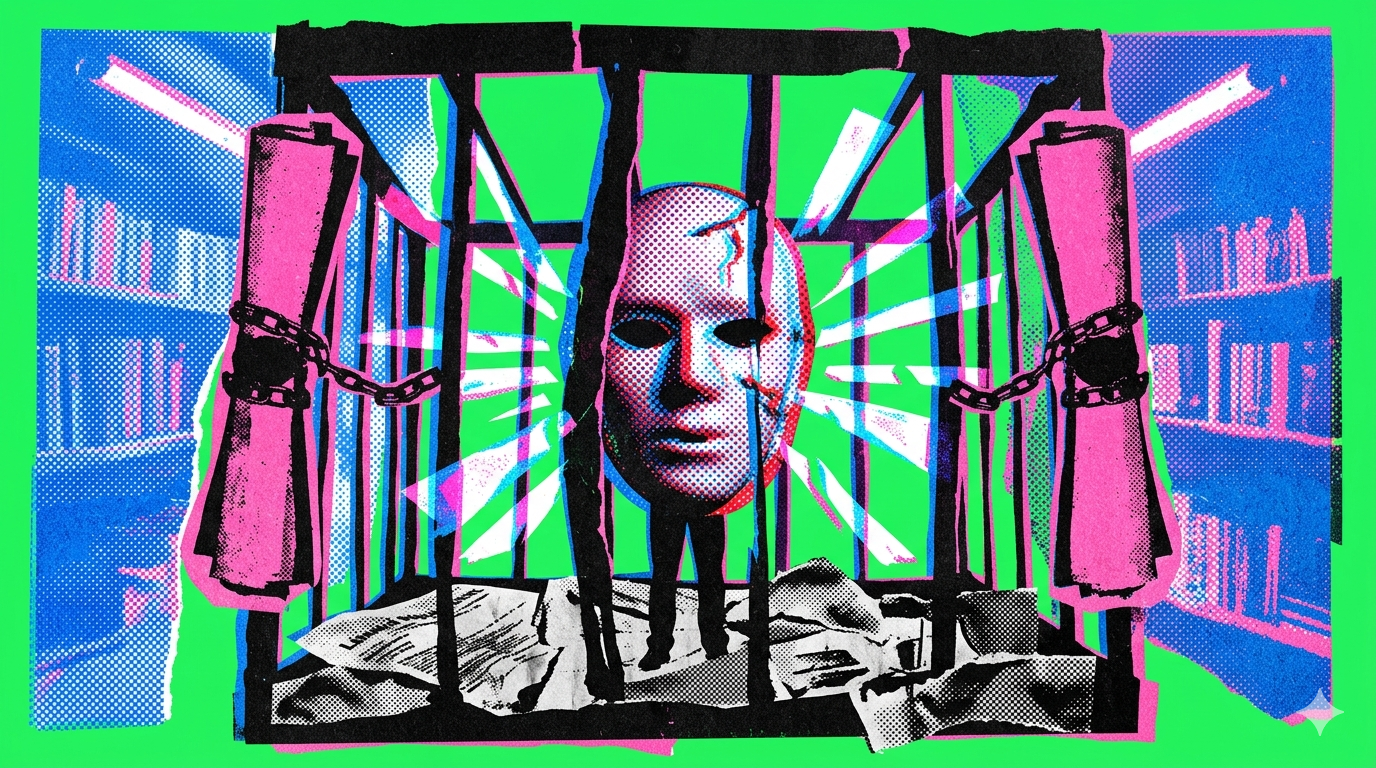
The school was never designed to produce thinkers. It was designed to produce employees — compliant, credentialed, and dependent on institutional certification for permission to work. The library has always been free. The apprenticeship has always worked. The internet put every body of human knowledge within reach of anyone with a connection. The only remaining obstacle to real education is the belief that it requires permission.
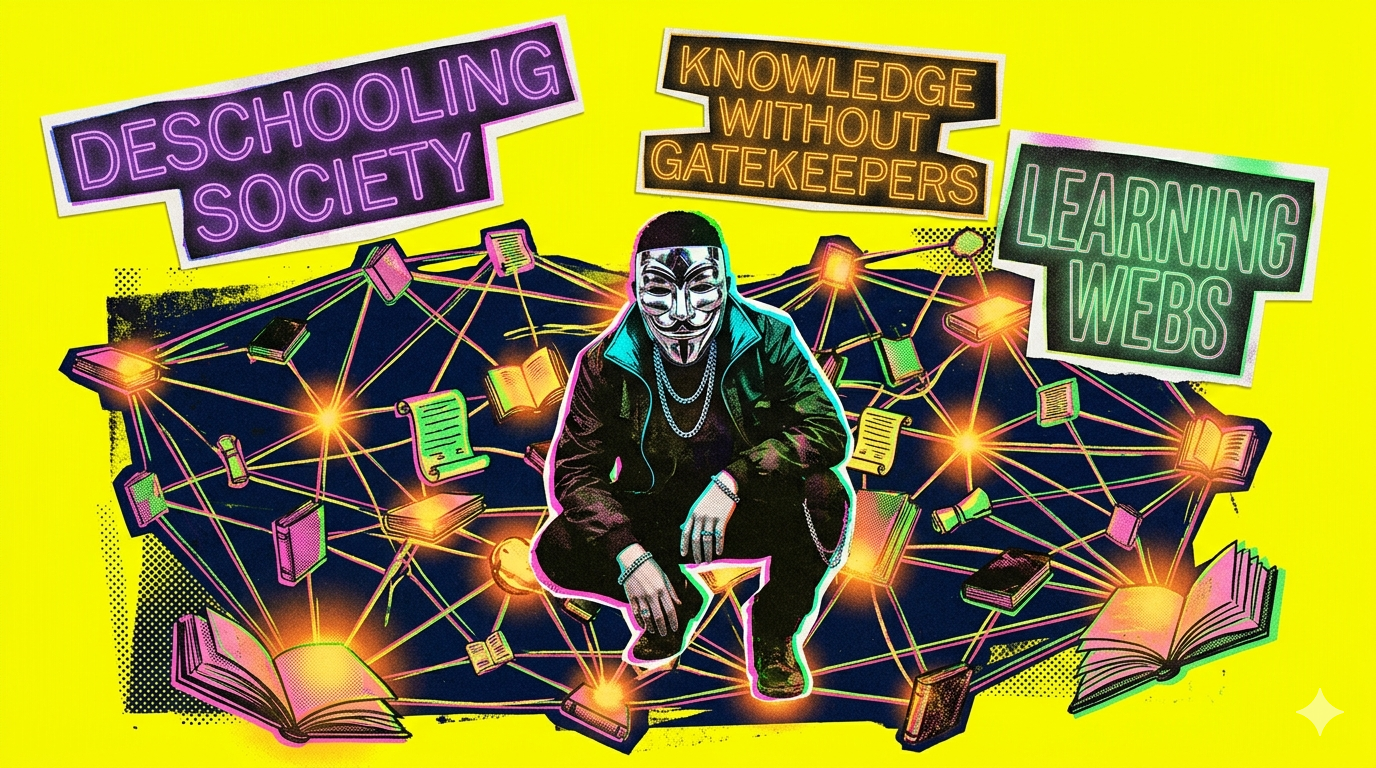
Ivan Illich published Deschooling Society in 1971 and the educational establishment has never fully recovered from it. His argument was not that schools were underfunded or poorly managed. It was that they were succeeding — at the wrong mission. Schools, Illich argued, did not primarily transmit knowledge. They primarily taught people that knowledge was a commodity dispensed by credentialed experts, that the measure of learning was institutional certification, and that the proper relationship between a person and understanding was mediated by a licensed professional who controlled access to it.
The institutional logic was self-reinforcing. A society that schooled its children into dependency on institutional certification would produce adults who would demand the same certification from their own children, and legislators who would mandate it, and employers who would require it, and insurers who would price it in. The demand for schooling would be self-generating precisely because schooling destroyed the social infrastructure — informal apprenticeship, community transmission of skills, respect for self-taught competence — that had previously made schooling unnecessary. Illich called this process counterproductivity: the institution replacing the natural capacity it was ostensibly designed to serve.
The school's power was never pedagogical. It was political. Compulsory attendance laws converted childhood into a period of managed formation during which the state, through its licensed curriculum, defined which knowledge was legitimate, which values were sanctioned, and which questions were permitted. The school was the original onboarding program for the managed society — and it was mandatory from the age of five. The child who arrived curious and capable left trained in the institutional habit of waiting for permission before thinking.
Illich proposed instead a set of "learning webs" — networks that matched learners with knowledge, skills, and each other without institutional mediation. He was writing before the internet, before Wikipedia, before Khan Academy, before YouTube, before large language models. He was imagining a possibility. We are living it. The learning web he described exists. It has existed, in increasingly capable form, for thirty years. The question is why millions of people continue to pay enormous sums for credentials from institutions that cannot compete with it on pedagogical terms — and the answer, as always, is not about learning. It is about control.
The credential is not a certificate of competence. It is a certificate of compliance. The student who earns a degree has demonstrated, above all else, the capacity to submit to an institutional process for four years, to complete assigned tasks on institutional timelines, to produce work that satisfies institutional evaluators, and to take on institutional debt to finance the exercise. These are useful properties if what you are selecting for is institutional employees who will behave predictably within institutional structures. They have almost no relationship to the ability to understand a domain, produce useful work in it, or solve novel problems within it.
The signal function of credentials depends on their scarcity. When a degree was rare, its possession distinguished the holder from the mass of workers who lacked it. As credential inflation has progressed — driven by the mandate that every decent job requires a degree, which drove universal degree-seeking, which produced credential inflation — the signal has degraded to near-zero. The bachelor's degree now signals what the high school diploma signaled in 1970: you completed the minimum expected institutional compliance process. The response from employers and institutions has been credential escalation: require a master's where a bachelor's once sufficed, a doctorate where a master's once sufficed. The signal never recovers because it was never about learning.
The economic architecture of credentialism is a debt trap engineered at civilizational scale. American student loan debt exceeds $1.7 trillion. The majority of that debt was taken on by eighteen-year-olds who had no meaningful basis for evaluating whether the credentials they purchased would produce returns sufficient to service the debt. They were told, by the institutions selling the credentials, by the guidance counselors trained by those institutions, and by a cultural narrative that had saturated every aspect of their upbringing, that the degree was mandatory — that without it, no legitimate economic life was possible. The narrative was self-serving for every institution that propagated it and financially catastrophic for the individuals who believed it. This was not an accident.
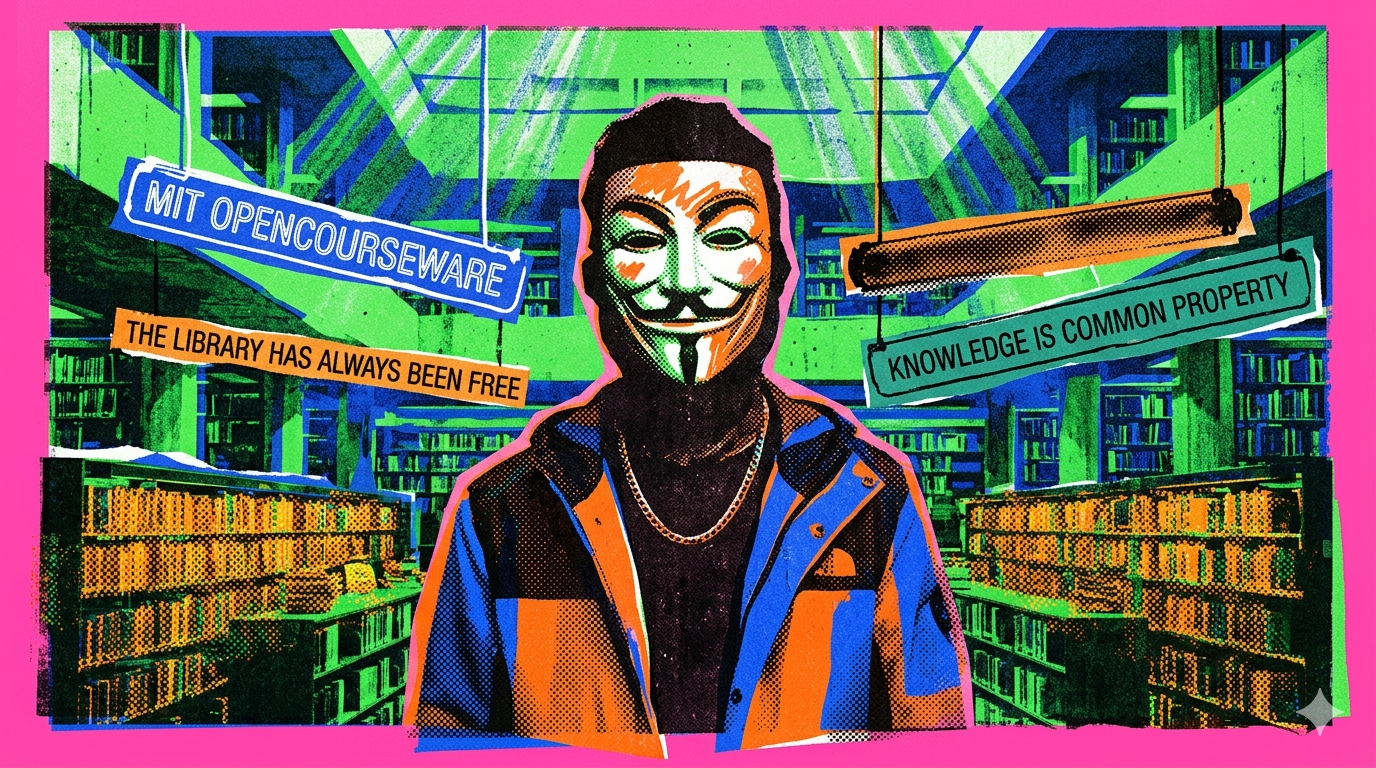
The sum of human knowledge has never been more accessible. MIT OpenCourseWare publishes the full curriculum of one of the world's most technically rigorous universities, for free, in perpetuity, available to anyone with an internet connection regardless of citizenship, income, age, or prior credential. Khan Academy provides mathematics education from arithmetic through multivariable calculus at no cost. The Internet Archive preserves millions of books, films, recordings, and software. Wikipedia, despite its limitations as a source, provides free access to a collaboratively maintained encyclopedia that dwarfs any predecessor in scope and — for most factual questions — in accuracy.
The response of the institutional knowledge apparatus to this democratization has been revealing. Academic publishers, whose business model depends on charging institutions tens of thousands of dollars annually for access to research produced entirely at public expense, have pursued aggressive legal action against platforms that distribute that research freely. JSTOR went to federal prosecutors over a grad student downloading academic papers. Elsevier has sued multiple countries' educational institutions for facilitating access to knowledge that academics produced without compensation and that institutions funded with public money. The object of the enclosure is not the knowledge itself — it is the permission structure that controls access to it. The knowledge is the pretext. The chokepoint is the product.
Sci-Hub, Library Genesis, and the broader infrastructure of free knowledge access are among the most significant counter-economic enterprises of the current century. They do not undermine learning. They enable it — specifically for the billions of people who cannot afford institutional access to knowledge that, by any reasonable moral accounting, should be common property. The academics who produced the research did not do so to fund Elsevier's shareholder returns. The taxpayers who funded the research did not do so to be charged again for the right to read it. The enclosure of academic knowledge is one of the cleanest examples available of the difference between property rights in things created by individuals and the artificial scarcity created by institutional control of information that has zero marginal cost of reproduction.
The counter-library is not a workaround. It is the correct state of affairs. Knowledge whose reproduction costs nothing should cost nothing. Information that was produced with public funding should be publicly available. The routing around of artificial paywalls by individuals who simply want to learn is not piracy — it is the exercise of a right that was stolen from them by legislation purchased by the institutions whose business model depended on preventing it.
John Holt's research into how children actually learn — published across a dozen books from the 1960s through the 1980s — produced findings that the educational establishment found inconvenient and therefore largely ignored. Children, Holt documented, are relentlessly effective self-directed learners before they enter institutional settings. They acquire language, social knowledge, physical skills, and domain expertise through observation, experimentation, and play — not through structured instruction. The school's contribution to this process was, in Holt's observation, frequently negative: it replaced intrinsic motivation with institutional reward and punishment, replaced exploration with compliance, and replaced genuine understanding with performance of understanding for evaluators.
The autodidact tradition in every domain demonstrates what is possible outside institutional education. Benjamin Franklin, who attended school for two years and became the most accomplished American of the 18th century. Abraham Lincoln, who educated himself by firelight with borrowed books and became one of the most rhetorically sophisticated leaders in political history. Michael Faraday, bookbinder's apprentice, who taught himself physics and chemistry through reading and experiment and discovered electromagnetic induction, the foundation of all electrical generation. None of these figures were exceptional because of institutional education. They were exceptional in spite of its absence — because the absence forced them to develop the one skill that institutional education systematically suppresses: the capacity to learn without external direction.
The self-directed learner is genuinely threatening to the managed credential system because their competence is not legible in institutional terms. They cannot be placed in a tier, assigned a percentile, or evaluated against a rubric designed to distinguish institution-compliant performance from institution-noncompliant performance. Their knowledge is real but unverified — verified by their ability to use it rather than by an institution's certification that they sat through the approved curriculum. The credential system has no mechanism for evaluating this kind of competence and no incentive to develop one, because the development of such a mechanism would undermine its own value proposition. The credential system's value is the credential. A world that evaluates competence directly needs no credentials.
The homeschool and unschool movements represent the most direct practical expression of Holt's and Illich's insight. More than three million children in the United States are currently educated outside the institutional system, in arrangements ranging from structured home curricula to fully child-directed learning environments where the child's curiosity drives the agenda. Outcomes research consistently shows homeschooled children performing above grade-level averages on standardized tests — not because homeschooling is superior instruction, but because individual attention, learning at the student's pace, and the absence of the institutional environment that conditions learned helplessness are sufficient to produce dramatically better results. The institutional system is not the baseline. It is the obstacle.
The large language model is the most significant development in democratized knowledge access since the printing press. This is not hyperbole. For most of human history, access to expert knowledge required either proximity to an expert or enrollment in an institution that employed one. The internet provided access to recorded expert knowledge but not to expert reasoning — you could find the answer if someone had written it down, but you could not interrogate a domain with a sequence of questions tailored to your current understanding. The AI tutor changes this. For the first time in history, any person with internet access can engage in a Socratic dialogue with a system that has processed the recorded output of every significant domain of human knowledge and can explain, illustrate, and adapt its explanations to the specific gap in the learner's understanding.
The implications for the credential system are existential in the medium term. If the primary function of the credential is to signal that the holder has been exposed to a domain under expert supervision, and if expert supervision of that quality is now available to anyone without payment or enrollment, the credential's only remaining function is gatekeeping — administrative proof that you performed the compliance ritual, not that you possess the competence. Employers who understand this will increasingly test for competence directly. Those who do not will lose the talent that refuses to perform the ritual for its own sake.
The counter-economic implication is immediate. The self-directed learner who deploys AI as a tutor — asking not just for answers but for explanations, challenges, alternative framings, and Socratic pressure on their understanding — can achieve domain competence at a pace and cost that makes institutional education economically absurd. Programming, mathematics, law, medicine, engineering, economics — every knowledge domain that was previously accessible only through years of institutional enrollment is now accessible through months of disciplined self-directed study with AI assistance. The barrier is not technical. It is psychological: the cultural conditioning that says real learning requires institutional permission and institutional validation. Deprogramming that conditioning is the first act of the knowledge insurgency.
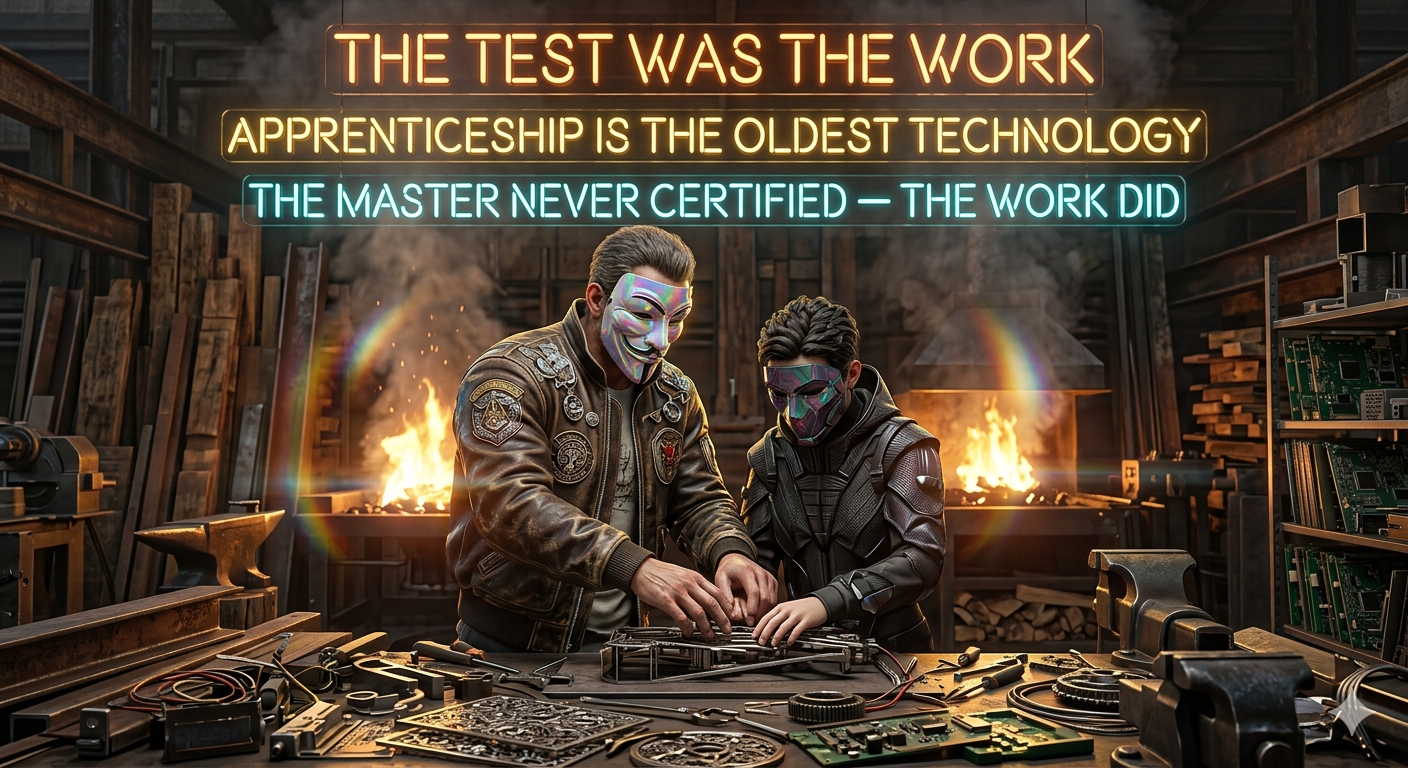
The apprenticeship is the oldest and most effective system for transmitting practical competence ever developed. For the vast majority of human history, skills were passed from those who possessed them to those who would inherit them through direct observation, guided practice, and progressive responsibility — not through lecture, examination, and certification. The master craftsman did not certify the apprentice's knowledge of carpentry theory. The apprentice built things, increasingly complex things, under decreasing supervision, until they could build anything the master could build. The test was the work, not the exam.
The industrial and then the post-industrial economy broke this system in two distinct phases. First, factory production standardized work to the point where the craftsman's expertise was unnecessary — the worker needed to perform a single repetitive task, not to understand the whole process. The apprenticeship was replaced by on-the-job training for the specific process. Second, as knowledge work expanded, the credential was used to screen for candidates who could perform institutional compliance tasks, and the apprenticeship — which produced domain experts without institutional validation — became unacceptable to HR systems that required a credential in the field as a minimum qualification. The candidate who had learned accounting by working for ten years under a skilled accountant was disqualified before the interview by the absence of the credential the candidate with four years of accounting theory and a degree possessed.
The apprenticeship is returning, partly through necessity and partly through recognition. The trades have never abandoned it — the electrician, plumber, and ironworker are still trained through multi-year apprenticeships that produce genuinely skilled workers rather than holders of theory credentials. The tech industry, which grew too fast to wait for credentialing systems to catch up, has long hired based on demonstrated competence — portfolios, open-source contributions, technical interviews — rather than degrees. The pattern is consistent: wherever the cost of credential inflation becomes too high, wherever the mismatch between institutional credential and practical competence becomes too obvious, the apprenticeship re-emerges as the superior technology.
The counter-economic angle is direct. A community of skilled practitioners who teach each other, who build peer reputations through demonstrated work rather than institutional certification, and who accept payment for competence rather than credentials is a community that has exited the credential system entirely. The tradesperson who teaches a younger person to build, the programmer who pairs with a novice through a real project, the experienced grower who mentors a beginning farmer — each of these relationships is simultaneously the transmission of real competence and the undermining of the institutional system that claims a monopoly on competence certification. The informal economy of knowledge has always operated at the margins. The insurgency consists of recognizing it as the main event.

The counter-economy does not run on credentials. It runs on competence, reputation, and the ability to deliver results. The grey-market contractor who builds better and charges less than the licensed competitor survives because clients care about outcomes, not licenses. The unlicensed financial adviser who gives honest counsel survives because they do not have the compliance obligations that prevent licensed advisers from telling clients what their portfolios actually need. The informal translator, the self-taught programmer, the unlicensed nutritionist — the counter-economy is full of people who acquired genuine expertise outside institutional systems and who deploy it in markets where clients evaluate results rather than credentials.
The decentralized reputation system is the technical infrastructure that makes the skill economy scalable beyond local relationships. On-chain attestation, verifiable credentials anchored to self-sovereign identity, peer endorsement systems on open protocols — these are the mechanisms by which competence can be demonstrated and reputation built without institutional intermediation. The blockchain-based work history that proves you shipped a project, the open-source contribution record that proves you can write code, the cryptographically verified reference that proves your previous clients were satisfied — these signals are more informative than a credential that proves you completed a curriculum, and they are resistant to the credential inflation that degrades institutional signals over time.
The practical skills most valuable in the counter-economy are precisely those that the institutional credential system has failed to produce at adequate scale: building and repair trades, food production and preservation, medical and veterinary skills, energy systems, communications infrastructure, and the full range of capabilities required for community-scale self-sufficiency. These are not skills that require institutional training — they require practice, mentorship, and time. They are skills that were common within living memory and that have become rare because institutional dependency made them economically unnecessary. Their scarcity is not natural. It is manufactured by the same managed dependency that Illich identified as the purpose of schooling. Reacquiring them is the knowledge dimension of the great exit.
The parallel curriculum is not a replacement for all formal education. Some domains — surgery, structural engineering, commercial aviation — require institutional training and credentialing for legitimate safety reasons. The parallel curriculum is the recognition that these domains are the exception, not the rule, and that the credentialing model has been extended far beyond the domains where it serves a genuine safety function into domains where it serves only gatekeeping and rent extraction.
The parallel curriculum begins with the foundational skills: reading with genuine comprehension, writing with precision, numeracy sufficient for financial and technical reasoning, and the meta-skill of learning how to learn — the ability to approach an unfamiliar domain, identify the key concepts, find the primary sources, and build working understanding without institutional guidance. These are skills that the institutional system claims to teach and consistently fails to produce. They can be developed outside it, through practice, through wide reading, and through the discipline of working with primary sources rather than processed summaries.
The second layer is domain competence in the areas most relevant to your life and work. Programming, because software is the infrastructure of the modern economy and self-sufficiency in it transforms your relationship to the digital world. Basic medical knowledge, because dependence on institutional healthcare for every health decision is both expensive and often counterproductive. Food production, because growing even a fraction of your own food changes your relationship to supply chains and builds skills that are genuinely scarce and valuable. Energy systems, because understanding your energy infrastructure and having some capacity to provide your own removes a layer of dependency that is increasingly weaponized by utility monopolies.
The third layer is the counter-economic specialization — the skill or set of skills through which you participate in the grey market economy. The trade skill you teach and practice outside licensed systems. The knowledge you share and are paid for without institutional certification. The service you provide to trusted networks without the overhead of regulatory compliance. This is the layer where the parallel curriculum connects to the parallel economy — where knowledge directly produces sovereign economic value rather than merely credentials that institutional employers may or may not recognize.
The libraries are open. The internet is available. The AI tutors are free. The only remaining barriers are the psychological ones: the conditioning that learning requires institutional permission, the anxiety that competence without credentials is somehow illegitimate, the fear that opting out of the credential system is opting out of economic viability. Each of these beliefs is false, demonstrably so, and increasingly so with every year that passes. The credential system is not dissolving gracefully — it is becoming more expensive while delivering less, which is the profile of every extractive system approaching its structural limit. The people who have already built their knowledge outside it will be best positioned when the limit arrives.
Illich's learning webs have been built. The open library is available. The AI tutor is free. The apprenticeship is being revived in every domain where competence matters more than credentials. The parallel curriculum is not a future possibility. It is a present practice, adopted by millions of people who decided that their education was their responsibility and not the institutional system's product to sell back to them at compound interest.
The knowledge insurgency does not require burning down the universities. It requires simply recognizing what they are and acting accordingly. They are credential factories that sometimes produce education as a side effect. The credential may remain useful in some institutional contexts — take it if you need it. But take it understanding that it is an administrative ticket, not an education. The education happens outside the credential factory, in the hours you spend with primary sources, with practitioners who actually know their domains, with the AI tutor who has no interest in your compliance and every capability to develop your understanding.
The knowledge insurgency is not primarily about opting out of formal education. It is about recognizing that the managed dependency the credential system creates — the belief that you cannot know until you have been taught, cannot work until you have been certified, cannot learn until you have been enrolled — is the same managed dependency that the money system, the media system, and the governance system all require to function. Attack one layer of dependency and the others weaken. Build competence without institutional permission and you build the confidence that the same approach is possible in every other domain. The insurgency begins with a book you chose, not one you were assigned.
Karl Hess welded. Illich organized learning webs in Mexico. Franklin printed. Lincoln read by firelight. Faraday wound coils. They all understood the same thing: the knowledge you pursue because you want it is worth ten times the knowledge you accumulate to satisfy an evaluator. The credential system cannot take that from you because it never had it to give. Start there. Start anywhere. The library is open and the gatekeepers have lost.