The theft you noticed was not the first theft. The wages extracted, the data harvested, the attention monetized, the decisions governed — these are visible enough to name, resist, and route around. What came before them was harder to see precisely because it was more thorough. Before the state took a percentage of your labor, it took something prior: the inner architecture that would have made your labor genuinely yours. Your community bonds. Your practical relationship to the physical world. Your felt sense that the processes sustaining your life were ones you could understand, influence, and eventually reproduce. What follows is an account of that earlier expropriation — and of the counter-economy that begins, necessarily, from the inside out. The deepest form of sovereignty is not financial. It is existential. And it was taken first.
The standard counter-economic critique begins with what is legible: the tax, the regulation, the surveillance architecture, the captured institution. These are the visible instruments of managed dependence — measurable, documented, and increasingly understood by anyone paying attention. What is less visible, because it was removed before the critique could be formed, is the substrate upon which all of these instruments operate. The state did not become effective at extracting compliance from populations who retained rich inner lives, dense community bonds, and a felt competence over the conditions of their own existence. It became effective after those things had been removed.
This is the invisible theft — the expropriation that precedes and enables all subsequent expropriations. A person with genuine community bonds is not easy to isolate and manage through fear. A person with practical sovereignty over food, shelter, energy, and health is not a reliable consumer of the solutions the system provides. A person with a rich inner life and a sense of inherent meaning does not need to purchase the curated identity and manufactured belonging that the attention economy sells. The extraction machine requires, as its operating condition, a population that has been pre-stripped of the resources that would make them ungovernable.
The sequence matters. The disenchantment of the population — the severing of community bonds, the removal of practical competence, the managed atrophying of inner life — was not a consequence of industrial modernity that incidentally served certain interests. The record is too consistent across too many domains to sustain that reading. The school that replaces the community as the transmitter of knowledge, the hospital that replaces the household as the manager of health, the supermarket that replaces the household as the producer of food, the algorithm that replaces the community as the source of belonging: each of these represents a domain transferred from human capacity to institutional management at precisely the same moment that the human capacity to perform that function was systematically removed.
The critique of the visible apparatus — the CBDC, the digital ID, the social credit architecture — is correct as far as it goes. But it addresses the endpoint of a much longer project. Understanding what happened before that endpoint is understanding what was done first, to whom it was done, and what recovering it actually requires. The counter-economy that begins only with financial tools is building on ground that was cleared long before the tools arrived.
In the intellectual history of Western modernity, the Enlightenment occupies the position of self-declared hero — the movement that liberated human beings from superstition, tribalism, and hierarchical authority and replaced them with reason, individual autonomy, and the freedom of the emancipated mind. The narrative is not entirely false. What it systematically conceals is the other thing the Enlightenment accomplished, the thing that served different interests entirely: the severing of human beings from the web of relationships, practices, and meaning structures through which ordinary people had organized their lives for millennia.
The materialist worldview was not merely a philosophical discovery. It was, in its social function, a technology of control. A world that has been successfully disenchanted — stripped of inherent meaning, of the sacred embedded in practice, of the community bonds that made individual life something larger than itself — is a world of isolated individuals who can be managed by institutions that offer to supply the meaning and belonging that the disenchantment removed. This is not a coincidence. It is the structural logic of what happened.
The village healer, the seasonal farmer, the craftsperson with an embodied understanding of the materials they worked, the community with a collective memory of how to navigate its particular land and climate — these were not superstitious primitives awaiting rational correction. They were repositories of accumulated knowledge, organized within social structures that transmitted that knowledge across generations without institutional intermediary. Their displacement by professional certification, industrial supply chains, and centralized expert authority was not the liberation of knowledge from the confines of tradition. It was the capture of the knowledge domain by institutions that could extract revenue from it — and the systematic elimination of the human capacity to operate independently of those institutions.
Kingsnorth traces this as the Western Deviation — the particular civilizational bargain struck in the collision of the exaltation of human will, Faustian ambition, and the mechanistic philosophy that followed. Whatever its origins, its effects are legible: the disenchanted world is one in which the felt relationship between human beings and the living processes that sustain them has been severed so completely that the severance itself is invisible. The managed person does not experience their dependency as a loss. They experience it as the normal condition of modern life — which is, of course, exactly what makes it so durable.
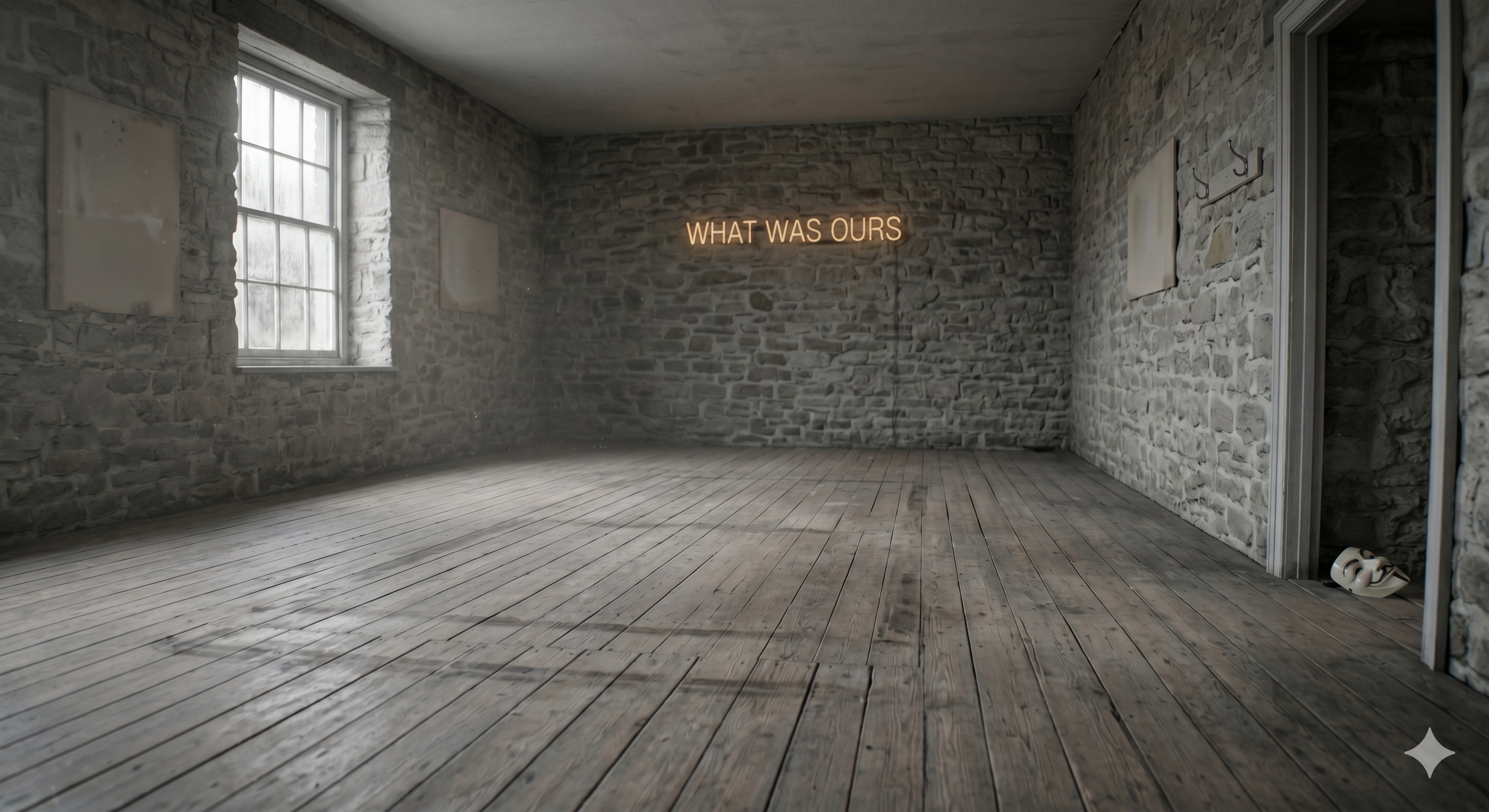
What Kingsnorth documents is not nostalgia. It is forensics. The loss of the local pub is not a sentimental story about people who miss their beer. It is the disappearance of the primary institution of working-class community — the place where informal networks of mutual aid were maintained, where local information circulated, where the social tissue that makes neighborhood life something more than proximity was generated and sustained. When it closes, it does not leave an empty building. It leaves an empty function, and the function does not stay empty. It is filled by a managed alternative — the digital social network, the subscription streaming service, the curated experience — that generates the surface affect of belonging while systematically preventing its substance.
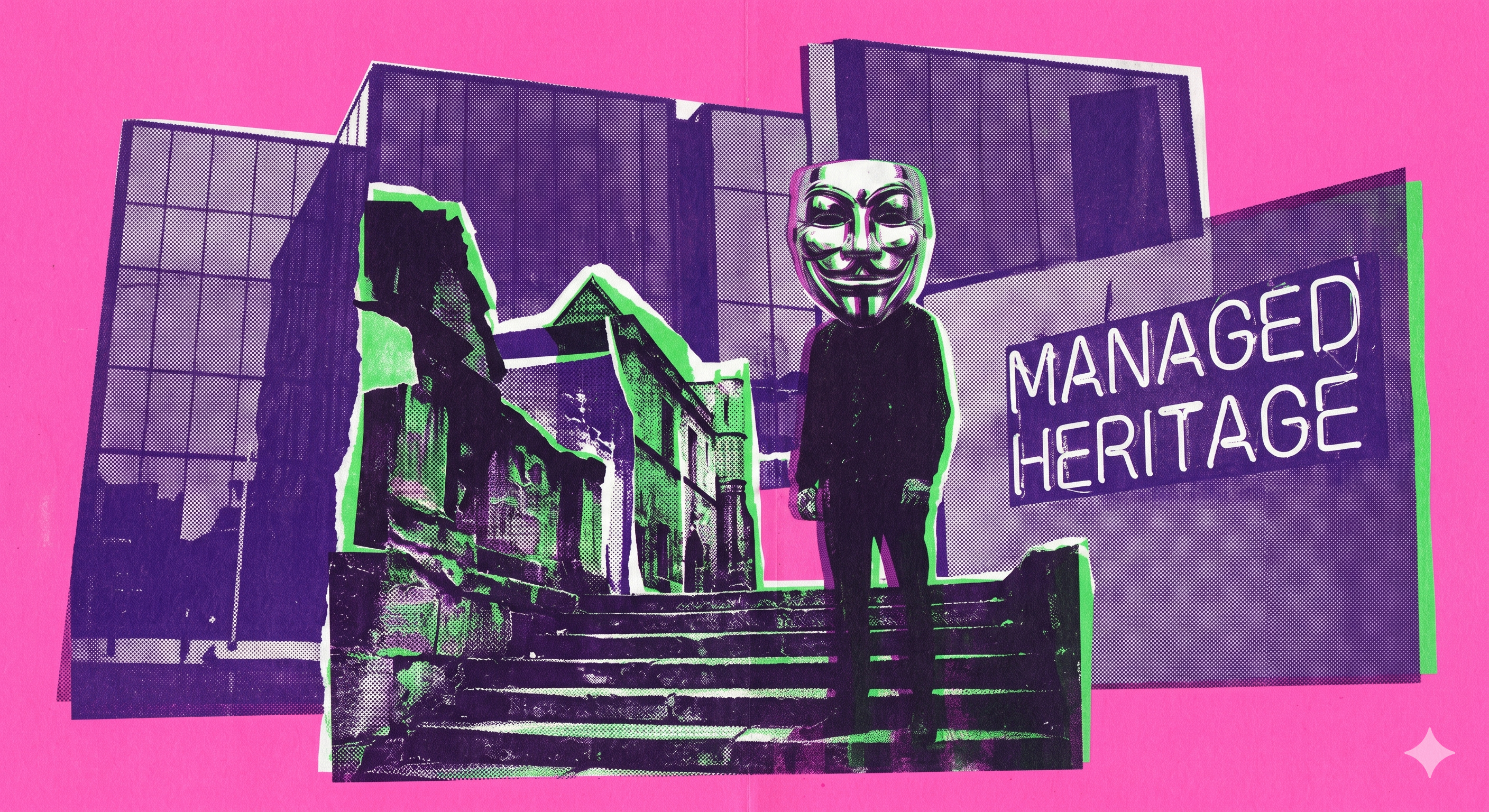
This is the Machine's essential method. It does not simply remove what is irreplaceable. It replaces it with a simulacrum that produces enough of the relevant signal to prevent the loss from registering as loss, while failing to deliver the actual thing. The strange regional culture that the Machine absorbs into the tourism industry is still there in a sense — there are pictures of it, curated experiences of it, tastefully preserved artifacts of it. What is gone is its living quality: its ability to be strange, difficult, evolving, genuinely local, operating on its own terms rather than the terms of external legibility. The Machine requires everything to be legible — quantifiable, indexable, monetizable — and legibility is precisely what destroys the quality that made the thing worth inhabiting.
The destruction operates in silence because it is gradual and because each generation accepts the diminished environment of its childhood as the baseline of normality. The ecologist calls this shifting baseline syndrome — the ratchet by which each successive state of loss becomes the reference point against which further loss is measured. The generation that grew up without the commons does not experience its absence as a loss. They experience it as the way things are. The function the commons served — the generation of community, the circulation of local knowledge, the social tissue that made neighborhood more than geography — is simply invisible to them as a need, because it has never been met.
The Hollowing is the Machine's most effective long-run strategy: not to destroy meaning directly, but to remove the material conditions in which meaning grows — one institution, one practice, one local culture at a time — slowly enough that each removal is invisible to those who did not witness what it replaced. By the time the removal is complete, there is no one left who remembers what was there. The absence has become the normal, and the normal has become the horizon of the possible.
The most underestimated instrument of social control is not the surveillance camera, the regulatory body, or the armed enforcement apparatus. It is the systematic destruction of the cognitive capacity to recognize the condition one is in. This is the mechanism that makes all the others sustainable at acceptable cost. A population that can accurately diagnose its situation and form coherent responses to it requires continuous, expensive, and ultimately unreliable coercion to manage. A population that has been cognitively restructured to be unable to form the diagnosis in the first place is self-managing at essentially zero institutional cost.
The psychiatrist Joost Meerloo, writing from direct clinical experience of the interrogation chambers of totalitarian systems, identified the mechanism with clinical precision. He called it menticide: the methodical installation of manufactured thought patterns, achieved not through a single dramatic act of indoctrination but through repeated waves of anxiety, isolation, and managed fear, followed by institutional calm that rewards compliance. The technique does not require that the target population believe the official narrative. It requires only that their cognitive capacity to form and sustain alternative frameworks be sufficiently disrupted. Repetition until questioning feels futile. Isolation until the social bonds through which independent sense-making occurs have dissolved. Complexity layered until the real structure of the situation feels inaccessible without expert guidance — which the institution conveniently provides.
What this produces is not a deceived population in the simple sense. It is a cognitively restructured one. The difference matters because deception can be corrected by the provision of accurate information. Cognitive restructuring cannot — because the mechanism of processing new information has been altered. This is why fact-checking approaches to institutional narrative consistently fail: they address the content of the message rather than the capacity of the receiver. A person whose baseline anxiety has been maintained at sufficient pitch, whose social bonds have been adequately attenuated, and whose sense of the situation's complexity has been properly managed cannot simply be shown contradicting evidence and update accordingly. The information does not arrive in a context that allows it to be processed.
The counter-economy's first act is not financial withdrawal. It is cognitive reclamation: the deliberate reconstruction of the inner conditions under which independent analysis becomes possible again. This requires community — because isolated individuals cannot recover the sense-making capacity that was dismantled through isolation. It requires primary sources over institutional summaries, direct experience over curated information, and the patient rebuilding of the social bonds within which genuine sense-making has always occurred. The agorist who understands only the economic dimension of exit has skipped the step that makes the exit legible to themselves.
The logical endpoint of the Endarkenment is a population that cannot reproduce the conditions of its own existence without purchasing them from an institutional intermediary. Not because the underlying knowledge does not exist — it does, distributed across communities and accumulated over millennia of direct human engagement with the physical world — but because the institutions have systematically made self-sufficiency economically unviable, legally constrained, and psychologically unimaginable. The managed subject is not primarily a victim of overt coercion. They are a product: manufactured by a system that required their dependency as an operating input and designed its institutions to produce it accordingly.
Illich named the mechanism counterproductivity: the point at which an institution designed to serve a human need begins producing the opposite of that need at scale. The school that creates an incapacity for self-directed learning. The hospital that generates iatrogenesis as its third-largest output. The transportation system that destroys the possibility of walking. The food distribution network that makes home production economically irrational and then culturally invisible. Each institution achieves radical monopoly not by being superior to the human alternative but by destroying the human alternative's conditions of possibility — through regulation, through the economics of scale that undercut local production, through credentialing systems that render informal knowledge unrecognizable, through an education that produces people who have no felt relationship with the physical processes of their own sustenance.
The resulting population is not unintelligent. It is structurally dependent in a way that is largely invisible to itself because the dependency is the water in which it swims. The question "what would you do if the supply chain failed for a month?" produces, in most contemporary urban populations, not a plan but an anxiety — because the answer is genuinely unknown, and the unknown has never been confronted because there has never been reason to confront it. The velvet cage is the arrangement in which the bars are sufficiently padded that the occupant does not experience themselves as imprisoned. Comfort is the delivery mechanism of compliance.
What is being assembled, piece by piece, is a system in which every remaining domain of self-sufficiency is brought within the institutional framework: programmable money that restricts what can be purchased, digital identity systems that govern access to services, behavioral compliance monitoring that makes the cost of non-conformity sufficiently high that it effectively eliminates the option. The Dependent Species is not the endpoint of accidental drift. It is the product specification — and understanding it as such is the beginning of deciding to be something else.
In 1548, a twenty-two-year-old law student in Bordeaux wrote what remains the most devastating analysis of political compliance ever committed to paper. Étienne de La Boétie asked a question that everyone before him had treated as unanswerable: why do populations submit to tyranny? The tyrant's army was always small relative to the population it controlled. The intelligence network could never be comprehensive enough to locate every potential dissenter. The tools of coercion were always, ultimately, insufficient to the scale of compliance they required. Yet the compliance was there, reliably, generation after generation. Where did it come from?
La Boétie's answer was as simple as it was devastating: it was given freely. The tyrant had no power that was not actively provided by those he tyrannized — by the army that enforced his decrees, by the bureaucrats who administered his laws, by the subjects who paid his taxes, by the ordinary people who went about their lives within the framework of a system whose authority rested entirely on their continued consent to treat it as authoritative. Remove the consent and the system fell. Not through revolution — revolution was itself a legitimizing act that engaged the system on its own terms and typically reproduced it in new clothes. Through withdrawal. Simple, quiet, systematic withdrawal of the participation that the colossus required to stand.
This was written 450 years before Konkin named the counter-economy and gave La Boétie's withdrawal its contemporary economic form. The continuity is not coincidental — it is structural. The vampire logic of counter-economics, in which every transaction shifted to the parallel economy removes revenue and legitimacy from the state simultaneously, is La Boétie's colossus applied in the domain of political economy. The ZK-proof that makes a financial transaction invisible to the state, the gray market operating below the regulatory threshold, the mutual aid network that makes the state's services unnecessary for a community: each is a stone removed from the pedestal.
But La Boétie's deeper insight — the one that the Endarkenment thesis makes newly urgent — is that the withdrawal must be genuinely sovereign to be effective. The person whose inner life has been colonized by managed entertainment and curated identity, whose community bonds have dissolved, whose cognitive capacity has been restructured through sustained anxiety and isolation: that person cannot withdraw, because they do not yet exist as the kind of subject capable of the act. The recovery of the self is not a precondition that can be deferred. It is the prerequisite for the fall of the colossus.

Before the counter-economy becomes legible in financial terms — in crypto wallets, gray market transactions, mutual aid networks, and the slow construction of parallel institutions — it must first exist somewhere less visible: in the interior life of the person who will run it. This is not a mystical claim. It is a practical one. A counter-economy requires counter-economic actors — people who have developed sufficient inner resources to act from genuine judgment rather than manufactured desire, who have enough community depth to distinguish authentic belonging from its managed simulacrum, who have enough felt competence over the conditions of their own existence to choose between the parallel system and the official one rather than simply drifting into whichever is most immediately available.
Konkin understood this in his own way when he framed agorism's project as the conversion of unconscious agorists into conscious ones. The unconscious agorist already participates in the counter-economy — buys in cash, trades skills informally, operates in the gray market out of practical necessity — but does so without a framework that makes the participation meaningful, transferable, or scalable. Consciousness is the difference between an isolated act of self-preservation and a political practice of structural withdrawal. And consciousness, in this context, requires exactly what the Endarkenment destroyed: an inner life sufficiently its own to recognize what it is doing and why.
Kingsnorth's Romanticism — his insistence on embeddedness, interiority, and the recovery of the felt sense of presence in a specific place — is not the opposite of agorism. It is its prerequisite. The practices he describes are not political programs. They are exercises in the recovery of sovereignty at the level where it was originally lost: in the quality of attention one brings to one's own existence, in the willingness to be genuinely present to a specific place rather than abstractly present everywhere, in the deliberate cultivation of real community rather than networked connection.
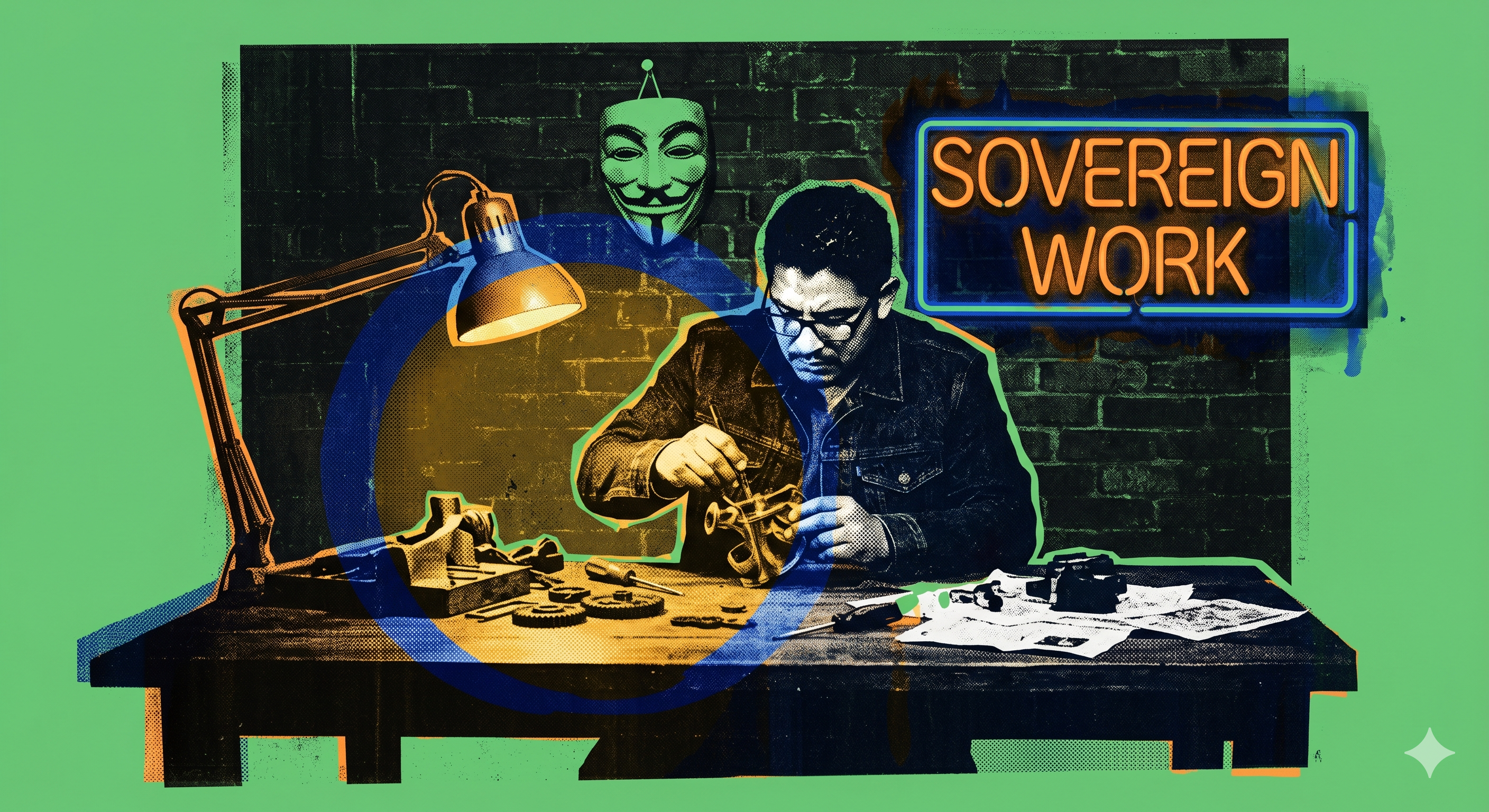
These are not aesthetic preferences. They are the conditions under which genuine counter-economic action becomes possible. The person who has developed a real relationship with a place — who knows its seasonal rhythms, who has grown food in its soil, who has built relationships with the specific people who live alongside them — has resources that cannot be expropriated through a payment freeze or dissolved by an algorithmic feed adjustment. The inner counter-economy is the infrastructure beneath the outer one. It is built from the same materials: attention, practice, community, and time. It requires no permission from any institution. It begins in the same moment as the decision to begin.
In the managed world, all human need flows through institutional intermediaries. The state taxes to redistribute. The platform monetizes connection. The charity requires ongoing dependency to sustain its own operation. The healthcare system manages rather than heals. Each intermediary extracts value at every step — in fees, in data, in compliance, in the gradual atrophying of the human capacity to perform the function without mediation. The institution does not merely provide the service. It becomes the definition of the service, restructuring the human need itself to require the institutional form.
Mutual aid short-circuits this architecture. When two people exchange a skill without charging a credential fee, when a community feeds its members without a nonprofit structure, when neighbors share tools without a rental contract, they are not merely performing a more efficient transaction. They are enacting a different ontology of human relationship — one in which need and capacity meet directly, without the institutional layer that captures value from their meeting. Mutual aid is not charity. Charity maintains a hierarchy between giver and receiver that mirrors and reinforces the institutional hierarchy it operates within. Mutual aid recognizes both parties as sovereign participants in a shared economy of care and competence, each with needs and each with capacities, exchanging them without requiring either to perform the institutional theater of application, eligibility assessment, and managed disbursement.
This is where the counter-economy's reenchanting function becomes most concrete. The disenchantment of social life operated through the progressive intermediation of all human relationship — the replacement of direct exchange between people who know each other with managed transactions between individuals and institutions. Every act of genuine mutual aid reverses this movement by one degree: it restores a direct human exchange in a domain where institutional mediation had displaced it. The person who teaches a neighbor to ferment, who fixes a stranger's bicycle, who organizes a community seed library, is not merely performing a useful service. They are re-establishing the relational fabric whose dissolution was the precondition of managed dependency.
The prefigurative dimension of this practice is what distinguishes it from political idealism. The reenchantment is not a promise about the society that will exist after the revolution. It is happening in the kitchen where the skill is being taught, in the garden where the seed is being shared, in the workshop where the repair is being made. The world being built is simultaneously the one being inhabited. Every act of direct human exchange is the counter-economy made flesh — the parallel civilization constructing itself in real time, one relationship at a time, in the spaces the managed world has not yet filled.
The deepest implication of the Endarkenment thesis is that the counter-economy cannot be built from the outside in. It requires sovereign actors — people who have done enough of the inner work that their participation in the parallel economy is genuinely chosen rather than reactively performed, who can sustain the practice through periods of friction and uncertainty without the institutional scaffolding that the managed world provides precisely to make its own forms of compliance frictionless. This is what Konkin meant, in his most exacting formulation, when he said that the agorist is not merely someone who avoids taxes or prefers sound money. The agorist is someone whose orientation to the world has been restructured around the principles of voluntary exchange, counter-economic withdrawal, and the conscious construction of the parallel civilization.
The Endarkenment thesis adds a dimension that the classical agorist framework underemphasizes: the inner life is not a byproduct of counter-economic practice. It is its foundation. The person who has reclaimed a genuine relationship with place — who has grown food, rebuilt community bonds, developed practical competence over the conditions of their own sustenance, and cultivated the cognitive independence that menticide systematically dismantled — does not merely have a stronger moral case for withdrawal. They have a stronger capacity for it. The vampire logic of counter-economics works more thoroughly when the people withdrawing have genuinely sovereign inner lives to withdraw into. The colossus falls faster when those pulling the pedestal away have somewhere real to go.
This is where Kingsnorth's Romanticism and Konkin's counter-economics converge on a point that neither tradition fully articulates alone. The Romantic practice of embeddedness — belonging to a specific place, attending to the unquantifiable, refusing the Machine's demand that everything be legible and monetizable — is not in tension with agorist counter-economics. It is its inner dimension. The outer counter-economy requires the inner counter-economy as its operating condition. Neither is sufficient without the other. The gray market that operates without community is precarious. The community that operates without counter-economic tools is isolated. Together they are something the extraction machine has not yet found an effective answer to: a parallel civilization with genuine roots.
What this means practically is that the Agorist soul is not an ideology but a constellation of practices, pursued in sequence and in community, accumulating in the direction of a life that the extraction machine has progressively less surface area to grip. It means reading primary sources. It means growing something. It means teaching something. It means belonging somewhere specific enough that the belonging is real. It means building the relationships in which the skills of the parallel economy can be exercised and transmitted across generations without institutional intermediary. The Endarkenment ended when someone decided to reverse it. That decision is always available. Always present tense. Always enough to begin.